
Every AI coding leaderboard ranks the same thing: accuracy. None of them ranks value. The most accurate model is usually the most expensive, and teams reach for it by default, or grab the cheapest one to save money. Both can be the wrong call, because the price on the invoice is not what an AI coding model actually costs you.
Cost and capability don’t move together
On a rigorous benchmark like DeepSWE, cost per task, output tokens, and runtime each vary by about tenfold across frontier models, and none of them tracks accuracy closely. The cheapest model in a recent snapshot ran about $3 a task; the most accurate, about $22. The expensive one is not seven times better. It solves roughly twice as many tasks. Paying more buys some accuracy, but not in proportion, and past a point barely at all.
So “expensive” and “good value” are different questions, and a leaderboard only answers the first.
The failure tax
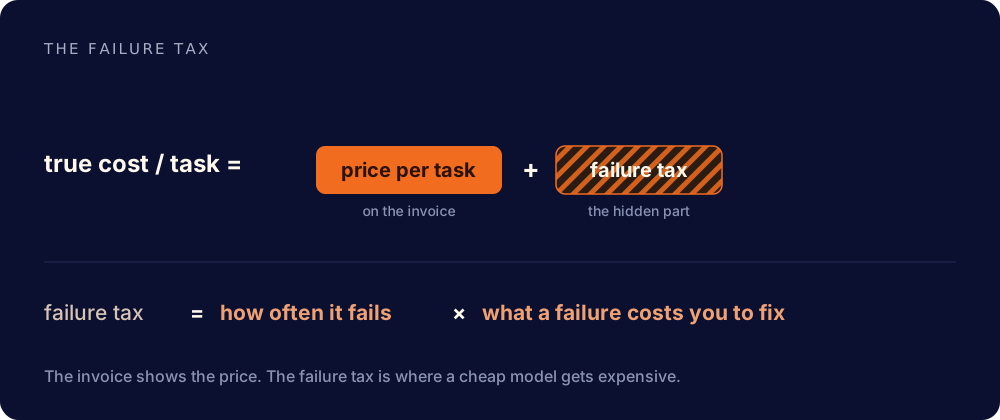
The invoice shows one number: what you pay the model per task. It hides the other: what you pay when the model is wrong. Every failed task lands on a person to finish or fix, and that costs real time. Call it the failure tax. The true cost of running a model on a task is the two added together:
true cost per task = price per task + (failure rate × cost to fix one failure)
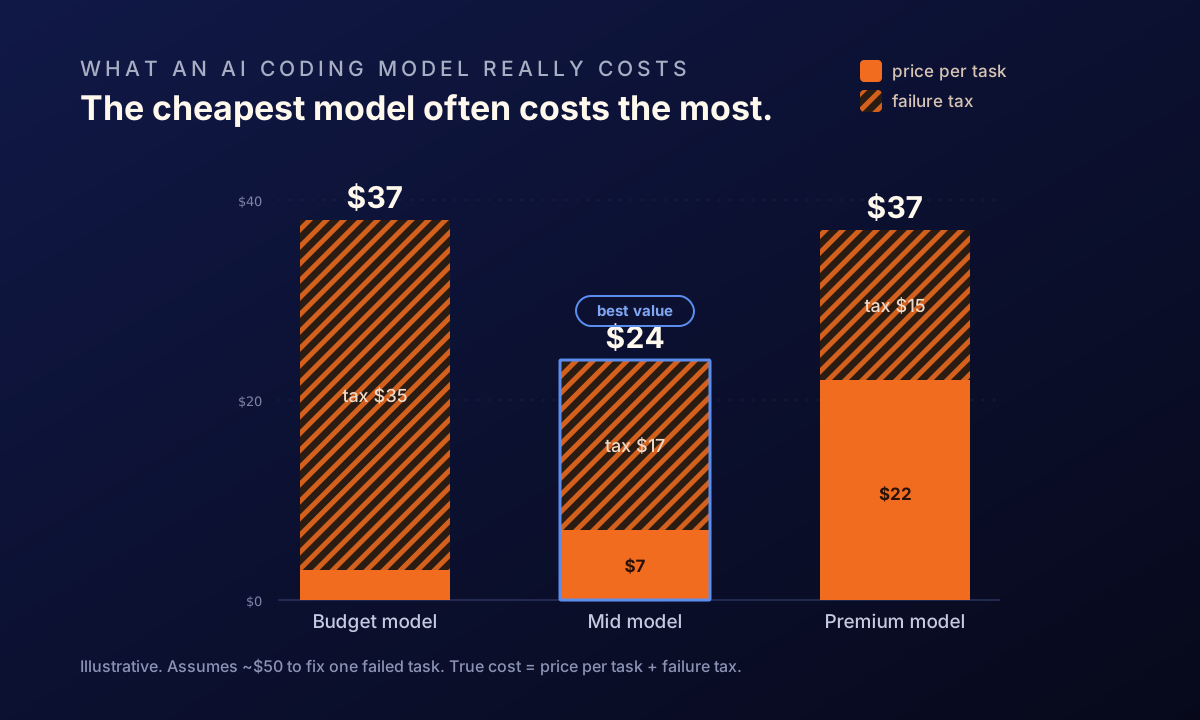
A model that’s cheap per task but fails often can carry a failure tax that dwarfs its price. Take the snapshot above and say a failed task costs $50 of an engineer’s time to clean up. The budget model at $3 a task and 31% accuracy carries a failure tax near $35, for a true cost around $37. The mid-tier model at $7 and 67% carries about $17 of tax, for a true cost near $24. The cheap model is the most expensive once you count what it leaves behind.
When the premium pays off
There’s a clean line for paying up. A more accurate model earns its premium once a failure costs more to clean up than the premium buys back in avoided failures:
pay for the better model when (cost to fix a failure) > (extra price) ÷ (extra accuracy).
Run it on the same snapshot:
| Upgrade | extra price ÷ extra accuracy | worth it once a failure costs more than |
|---|---|---|
| Mid-tier (67%, ~$7) over budget (31%, ~$3) | $4 ÷ 0.36 | ~$11 |
| Mid-tier (67%, ~$7) over the next model (52%, ~$6) | $1.58 ÷ 0.15 | ~$11 |
| Premium (70%, ~$22) over mid-tier (67%, ~$7) | $14.40 ÷ 0.03 | ~$480 |
The mid-tier model pays for itself over the cheaper ones the moment cleanup costs more than about $11, roughly ten minutes of an engineer’s time, which is nearly always. The premium model only beats the mid-tier one if a single failure costs around $480 to fix, and it’s buying a three-point accuracy edge that sits inside the benchmark’s margin of error, so it may not be real at all (why a leaderboard lead can be a statistical tie). The value-optimal pick is usually the middle: the most accurate model whose price hasn’t detached from its accuracy.
Not every failure costs the same
The failure tax has a second lever, and pass rate can’t see it: how a model fails. A loud failure, where the model gives up or writes code that obviously breaks, is cheap to catch. A silent failure, the confident and plausible code that passes review and breaks in production, is the expensive kind. Two models with identical accuracy can carry very different failure taxes if one fails loudly and the other fails quietly.
Pass rate counts how often a model is right. It says nothing about what being wrong costs you, and almost no public benchmark measures the second. A cheap, confident model can be the most dangerous of all, because its mistakes are the ones you don’t catch until they’ve shipped.
Match the model to the task
Because the answer depends on the cost of a failure, the cost-optimal setup is usually to route between models rather than pick one. Send low-stakes, easily-checked work like boilerplate and first drafts to a cheaper model, where a failure costs little. Reserve the accurate, more expensive model for work where a silent mistake is costly, such as anything touching production, money, or data you can’t easily reverse. Standardizing on one model for everything is rarely the cheapest answer.
Stakes are one axis. The kind of thinking a task needs is another, and it points somewhere different: our guide to picking between Claude and GPT for coding covers which of the current models to reach for on architecture versus interface work, and how to set the reasoning-effort dial, which is a second knob that carries its own version of this same break-even.
The numbers you can’t get from a leaderboard
Both inputs to the failure tax are yours, not the benchmark’s. Your failure rate isn’t the leaderboard’s, because a benchmark pass overstates real-world success and your codebase isn’t its test set. Your cost to fix depends on your team, your review process, and how loudly each model fails on your work. The only way to get those numbers is to run the candidate models on your own tasks and watch not just whether they pass, but how they fail. That’s the evaluation we build with clients, and the same discipline as testing any AI vendor on your own data before you buy.
Where we stand
We don’t sell models or take fees from the labs, so we have no reason to push the priciest option or the cheapest. We help teams put a real number on the failure tax for their own work, and the answer tends to land in the same place: not the top of the leaderboard, and not the bottom, but the model that’s actually worth it. That’s evidence over enthusiasm, applied to the invoice.