
An AI roadmap is easy to produce and easy to ignore. Most of them are the same document: a list of use cases everyone in the room already knew about, sorted into high, medium, and low, with a timeline that assumes nothing goes wrong. It gets nods in the meeting and then it goes in a drawer, because it never answered the question the executive walked in with. What do we do first, and why that one?
A roadmap that earns its place answers exactly that. It is a set of decisions, not an inventory of possibilities, and the decisions are the specific, slightly boring kind: this before that, for this reason; build this, buy that, leave the third alone. The value is not the list. It is that an executive can defend the order and an engineer can act on it the next morning.
Picture the version everyone has sat through. A leadership team is weighing three AI initiatives: automating customer support, standing up internal knowledge retrieval so staff stop hunting for answers, and fine-tuning a custom model on company data. The wishlist marks all three “high” and asks for budget for all three. The roadmap notices that two of them are mostly a buy-and-configure job that could ship this quarter, while the third is a months-long build whose payoff depends on data nobody has audited yet. Those are not the same kind of bet, and they do not belong in the same column.
A roadmap is a set of decisions, not a list
Most roadmaps fail to do anything because they were built from the wrong material. They start from what is possible, which is unlimited, instead of what is constrained, which is where the real answer lives. Possible use cases are cheap; anyone can name ten. The hard part is the part a wishlist skips: which of them your data can actually support, which your team can own, which survive a risk review, and which are worth doing before the others.
Start there and the document changes character. It stops being a catalog of AI things and becomes a short argument: here is where we think AI pays off, here is the order, and here is why each call went the way it did. A roadmap should settle arguments, not host them.
Build, buy, or ignore
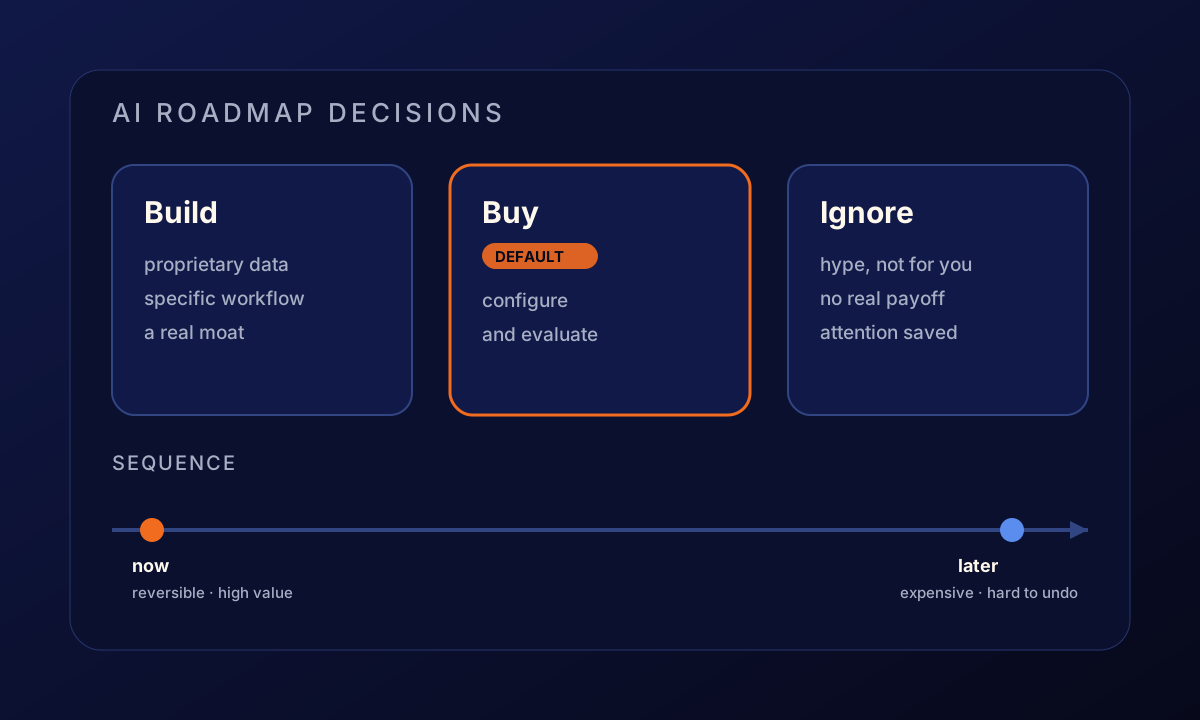
The decision underneath most of the others is build versus buy, and for most companies in 2026 the default should be buy, configure, and evaluate. Foundation models, coding assistants, document tools, customer-service layers: these are bought, configured, and tested against your own work, not written from scratch. Building your own is justified in a narrow set of cases, almost always where proprietary data, a specific workflow, or a real compliance boundary makes the off-the-shelf version genuinely worse for you. Everywhere else, building is how a company spends a year reinventing something it could have rented in a month. The most expensive line on a roadmap is usually the custom model funded for a problem three vendors already solve, because building felt more serious than buying.
The decision a roadmap skips most often is the third one: ignore. Not every capability in the news is a capability for your business. A good roadmap is as clear about what you are choosing not to chase as about what you are funding, because attention is the scarce resource, and a list with no “no” on it is just enthusiasm.
A roadmap should settle arguments, not host them.
Sequence by value and reversibility
Order is where a roadmap proves it was thought about. The instinct is to start with the most exciting initiative. The better instinct is to start where the value is real, the data already exists, and a wrong call is cheap to reverse. Early items should teach you something and leave you free to change your mind. The expensive, hard-to-undo commitments, a platform build, a data migration, a deep vendor lock, belong later, after the cheap experiments have told you what is actually true about your data and your users.
This is also how you keep momentum without betting the company. A sequence that front-loads reversible, high-value work produces evidence and credibility early, and that is what funds the harder moves. A sequence that front-loads the big irreversible build produces a year of risk before anyone knows whether the premise held.
Why roadmaps die
Most AI initiatives never reach production, and the reasons are rarely about the model. A 2024 RAND study, drawn from interviews with 65 data scientists and engineers, traced the leading causes of failure to things that have little to do with model quality: a problem framed wrong from the start, inadequate data, a focus on the newest technology instead of the actual problem, missing infrastructure, and AI pointed at problems it could not solve. Roadmaps die the same way. They are built from vendor demos instead of constraints, so they describe a world the company does not live in. They have no owner, so no one is accountable when the date slips. They treat AI as a one-time project to finish rather than a capability to operate, so nothing keeps a shipped system working after launch. And they are never tied to a real decision or budget moment, so they are easy to admire and easy to defer.
The fix for all of it is to make the roadmap answerable. Every item should carry a name, a reason it ranks where it does, and a decision it informs.
The roadmap test
Before you fund an initiative, score it one to five on four axes:
- Value. One is impressive in the abstract; five is a payoff that is real, specific, and measurable for your business.
- Feasibility. One needs an imagined future state of data and infrastructure; five is supportable by the data, systems, and people you already have.
- Reversibility. One locks you into a platform or vendor; five is cheap to undo if the call turns out wrong.
- Ownership. One belongs to “the team”; five has a named person accountable for the outcome.
A high value score does not rescue a low feasibility or ownership score; it only makes the gap more tempting to ignore. Anything that cannot clear a three on feasibility and ownership is a research project or a wish, not a roadmap item, whatever its value. Run the whole candidate list through the same four numbers and the order mostly sorts itself: the high-value, high-feasibility, reversible, owned work goes first.
So before you approve an AI roadmap, ask the simplest question in the room: which item would we start Monday, and why that one. If the answer is clear, specific, and yours, you have a plan. If it is “it depends” or “the vendor suggested it,” you have a wishlist with a nicer cover.